


The Best Ways to Add Cooling Without Ripping Down Your Drywall



Why Homeowners Are Rethinking Cooling Without Ductwork in the Lower Mainland
Adding cooling without ductwork options compared side by side is exactly what most BC homeowners need before making a decision — and the good news is you have more practical choices today than ever before.
If your home in Maple Ridge, Langley, Surrey, or anywhere across the Lower Mainland was built without central air ducts, you are not stuck sweating through another summer. Many older BC homes — especially those built before the 1970s — were designed around radiant heat, not forced air. Retrofitting full ductwork can mean tearing into plaster walls, losing closet space, and months of disruption. But that is rarely your only path forward.
Here is a quick breakdown of your main options:
| Option | Efficiency | Installation | Best For |
|---|---|---|---|
| Ductless Mini-Split | 16–35 SEER2 | 1–2 days, 3-inch wall hole | Whole-home or zoned cooling |
| High-Velocity Small-Duct | 14–18 SEER | Several days, minor construction | Historic homes, aesthetic priority |
| Window AC Unit | 10–15 SEER | DIY, minutes | Single room, temporary use |
| Portable AC Unit | 8–12 SEER | DIY, no install | Renters, very short-term needs |
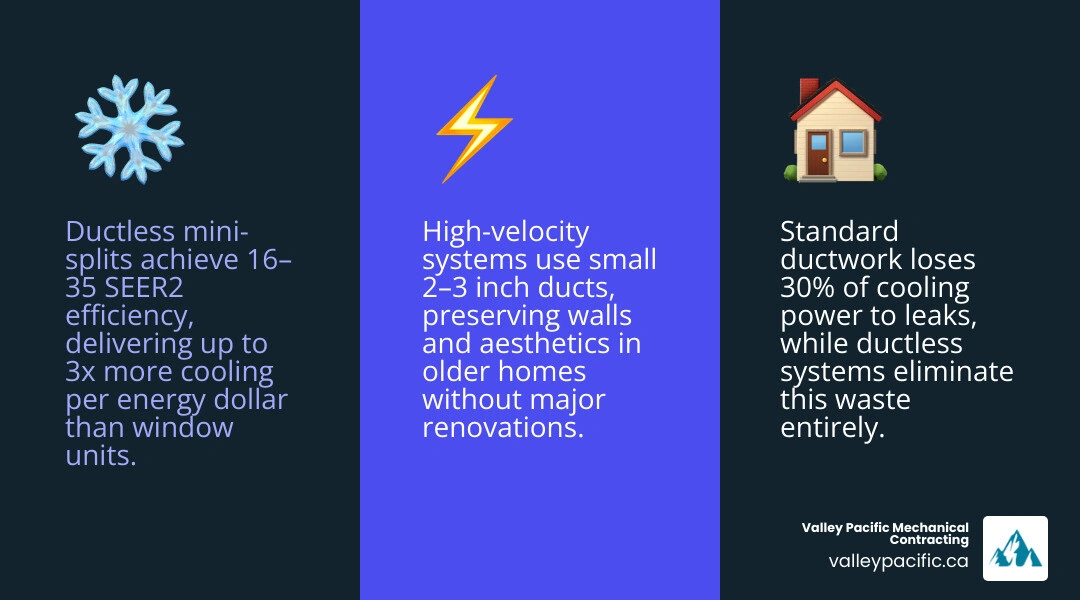
A key reason to look beyond window units and portable ACs: standard ductwork systems can lose up to 30% of cooling power through leaks and gaps — and window and portable units come with their own significant efficiency drawbacks. Ductless systems sidestep both problems entirely.
The sections below walk through each option in detail, including what works best for older Lower Mainland homes, what to expect from installation, and how to take advantage of available 2026 incentives.
Primary Options for Adding Cooling Without Ductwork Options Compared
When we look at the landscape of cooling in 2026, the primary goal for most of our neighbors in Pitt Meadows or Langley is to find a balance between comfort, energy bills, and home preservation. If you don't have existing ducts, you're essentially choosing between a permanent HVAC upgrade and a temporary "band-aid" fix.
Permanent Ductless Solutions
The most popular choice by far is the ductless mini-split. For a Ductless AC Installation, we only need to drill a small three-inch hole in an exterior wall to connect the indoor unit to the outdoor compressor. It’s a permanent solution that increases your home’s resale value and provides year-round climate control.
Another permanent option is the high-velocity system, which uses flexible, narrow tubing (about the size of a vacuum hose) that can be snaked through walls and ceilings with far less destruction than traditional metal ducts. These are fantastic for historic homes in places like Mission where preserving the original crown molding is a priority.
Temporary or Semi-Permanent Options
Window units and portable ACs are often the first things people think of because you can buy them at a big-box store and plug them in. However, when adding cooling without ductwork options compared to permanent systems, these fall short. Window units are noisy, block your view, and represent a security risk. Portable units are even less efficient; research shows that single-hose models can lose up to 40% of their cooling power because they create negative pressure, actually pulling hot outdoor air back into your home through small cracks.
If you’re looking for a long-term strategy, our Ductless AC Service Guide Pitt Meadows BC emphasizes that the "total cost of ownership" over five to ten years is almost always lower with a ductless system due to the massive energy savings.
Why Ductless Mini-Splits are the Gold Standard for BC Homes
In our 30+ years of experience serving the Lower Mainland, we’ve seen HVAC technology evolve significantly. As of April 2026, ductless mini-splits have firmly established themselves as the gold standard. Why? It comes down to "Inverter Technology."
Think of a traditional AC like a light switch — it’s either 100% on or 100% off. This leads to those annoying temperature swings. A modern mini-split is more like a dimmer switch or a car’s cruise control. The compressor speeds up or slows down to match the exact cooling needs of the room. This makes a Mini-split Installation incredibly efficient, with some systems reaching up to 35 SEER2 ratings.
The Daikin Comfort Promise
At Valley Pacific, we stand behind the Daikin Comfort Promise. These systems are designed for longevity and whisper-quiet operation. While a window unit might roar at 60 decibels (like a vacuum cleaner), a ductless indoor unit hums along at 19 to 32 decibels — quieter than a whisper in a library.
Beyond just cooling, these systems act as high-end air purifiers. They feature multi-stage filtration that can capture up to 99.9% of allergens and dust. This is a huge benefit for families in the Fraser Valley dealing with seasonal pollen or smoke. And if your unit ever hits a snag, Mini Split Repair is straightforward because the components are easily accessible to our licensed technicians.
Benefits of Zoned Cooling and Adding Cooling Without Ductwork Options Compared
One of the biggest wastes of money in a traditional home is cooling rooms that nobody is using. Why pay to keep the guest room at 20°C all day if you’re only in the home office?
Ductless systems allow for "zoned cooling." This means each indoor unit has its own thermostat. You can keep your bedroom crisp and cool for sleep while keeping the living room at a more moderate temperature.
- Energy Savings: Zoned cooling can reduce your energy consumption by up to 40% compared to a central system.
- No More Arguments: If one family member likes it chilly and another prefers it warm, everyone wins.
- Eliminating Hot Spots: Our Ductless AC Service Guide Maple Ridge BC highlights how zoning fixes those stubborn "hot rooms" over the garage or in the attic that central air never seems to reach.
Preserving Your Home’s Character with High-Velocity and Hybrid Systems
For those living in historic properties in Langley or Mission, the thought of mounting a white box on a 100-year-old plaster wall might be a deal-breaker. This is where high-velocity systems and hybrid approaches shine.
A high-velocity system uses a specialized air handler that forces air through small, flexible tubes. The outlets are tiny—often only two inches in diameter—and can be placed in ceilings, floors, or walls to blend in seamlessly with your decor. This is often the best Mini Split Installation Replacement alternative for homeowners who want the "invisible" look of central air without the massive ductwork.
These systems use the principle of "aspiration." Instead of just dumping cold air into a room, they create a gentle suction that mixes the air more thoroughly, resulting in very even temperatures. They also excel at dehumidification, typically removing 30% more moisture than conventional units—a blessing during those humid Lower Mainland July stretches.
Comparing High-Velocity Systems and Adding Cooling Without Ductwork Options Compared
When we look at high-velocity versus ductless, it’s a matter of aesthetics vs. raw efficiency.
- Aesthetics: High-velocity is nearly invisible. Mini-splits are visible but offer more modern "sleek" designs.
- Installation: High-velocity requires snaking tubes through the house, which takes longer than a ductless install but is still much cleaner than traditional ducts.
- Maintenance: Both require professional care. Regular Mini Split Service or high-velocity filter changes ensure the system doesn't work harder than it has to.
A "hybrid" approach is also common in our region. Many homeowners keep their existing hot water radiators for winter heating and add a Ductless AC Service plan for summer cooling. In fact, modern mini-split heat pumps can handle about 80% of your heating needs during the "shoulder seasons" (Spring and Fall), allowing you to leave the boiler off until the deep freeze hits.
Our Ductless AC Service Guide Mission BC and Ductless AC Service Langley BC Guide offer more localized tips on how to integrate these systems into different home styles common in our area.
Preparing Your Lower Mainland Home for a Ductless Upgrade
Before we install any system, we always recommend "Step Zero": preparing the home envelope. A high-efficiency AC system in a leaky house is like running a marathon with your shoes untied—you’ll get there, but it’s going to be much harder than it needs to be.
The "Step Zero" Checklist:
- Air Sealing: Older homes (especially pre-1940) can leak as much air as having a window open year-round. Sealing gaps around windows, doors, and baseboards can reduce cooling loads by 15-30%.
- Insulation: Improving attic insulation is one of the best ways to keep the summer heat from radiating down into your living space.
- Manual J Load Calculation: We don't just guess what size unit you need based on square footage. We perform a Manual J calculation, which accounts for your insulation, window types, and even which way your house faces. An oversized unit will "short cycle," meaning it turns on and off too fast to properly remove humidity, leaving you feeling clammy.
Rebates and Incentives in 2026
In 2026, the financial landscape for BC homeowners is very favorable. Between federal tax credits and provincial programs, you can significantly offset the cost of upgrading to a heat pump system.
- CleanBC Better Homes: Offers significant rebates for switching to energy-efficient heat pumps.
- BC Hydro Rebates: Often provides incentives for installing ENERGY STAR-certified systems.
- Federal Tax Credits: Currently, there are credits covering 30% of equipment and installation costs for qualifying heat pumps, up to a $2,000 annual limit.
- HPCN Requirement: To qualify for most BC rebates, you must use a contractor who is part of the Home Performance Contractor Network (HPCN).
Frequently Asked Questions about Ductless Cooling
Can a mini-split system handle the humidity and heat of a Lower Mainland summer?
Absolutely. In fact, they are often better at it than central air. Because the inverter compressor can run at very low speeds for long periods, it acts as a constant dehumidifier. Instead of the "blast of cold" followed by "rising humidity" you get with older systems, a mini-split maintains a steady, dry indoor climate.
How long does it take to install a multi-zone system in an older home?
For most homes in Maple Ridge or Langley, a three-zone system can be installed in just 1 to 2 days. We don't need to move you out or cover everything in plastic. The most "invasive" part is a small hole for the refrigerant lines, which we cover with a neat, color-matched "line set cover" on the outside of your house. It’s a very clean Mini-split Installation process.
Are there specific 2026 rebates available for BC homeowners?
Yes, the CleanBC Energy Savings Program has expanded for 2026, particularly for income-qualified households who may be eligible for even higher incentives—sometimes covering a vast majority of the project. The key is ensuring the system is ENERGY STAR Most Efficient certified and installed by a licensed professional.
Conclusion
Adding cooling to a home without ductwork doesn't have to be a headache. Whether you choose the ultra-efficient path of a ductless mini-split or the discrete integration of a high-velocity system, the technology available in 2026 is designed to keep your home comfortable while respecting its architectural history.
As an Indigenous-owned business with over 30 years of experience in the Lower Mainland, Valley Pacific Mechanical Contracting is here to help you navigate these choices. From Maple Ridge to Langley and everywhere in between, we provide licensed, expert service with a "headache-free" promise.
Ready to reclaim your home from the summer heat? Schedule your professional cooling assessment today and let us find the perfect ductless solution for your family.


