


Why BC Mild Winters are a Match Made in Heaven for Heat Pumps


I'm considering a heat pump for my home in Maple Ridge. What are the pros and cons for our Pacific Northwest weather?
Understanding the heat pump pros and cons for Pacific Northwest weather is one of the smartest things you can do before upgrading your home's heating and cooling system. If you live in the Lower Mainland — from Maple Ridge and Langley to Surrey and Vancouver — you already know the winters here are less about deep freezes and more about long stretches of grey, damp, cool days. That climate turns out to be nearly perfect for heat pump technology, which thrives when outdoor temperatures stay mild.
But "nearly perfect" isn't the same as "no drawbacks." Before making a decision, it helps to see the full picture at a glance.
Quick Answer: Heat Pump Pros and Cons for Pacific Northwest Weather
| Pros | Cons | |
|---|---|---|
| Efficiency | 300-400% efficient in mild PNW winters (COP 3-4) | Real-world efficiency is often 20-30% lower than rated |
| Comfort | Steady, gentle warmth all winter; cooling in summer | Some homeowners miss the strong "blast" of a furnace |
| Cold Snaps | Modern cold-climate models heat effectively at 5°F and below | Standard models may need backup heat during rare arctic blasts |
| Environment | No combustion; pairs well with BC's clean hydro grid | - |
| Maintenance | Fewer safety risks than gas systems | Year-round operation means more frequent servicing needed |
| Home Fit | Works with existing ductwork in most cases | Leaky ducts (which lose 30-60% of heat) reduce effectiveness |
The Pacific Northwest's mild, wet winters — where average December temperatures hover around 39.6°F (roughly 4°C) — create ideal conditions for heat pumps to operate at their most efficient. Add in BC's relatively clean electricity grid, increasingly hot summers, and growing adoption, and it's easy to see why heat pumps now appear in more than a quarter of regional homes. That share has grown significantly since 2017, and it keeps climbing.
That said, every home is different. The right answer depends on your insulation, your existing setup, your local microclimate, and how your household uses energy. The sections below break it all down in plain language so you can make a confident, informed decision.
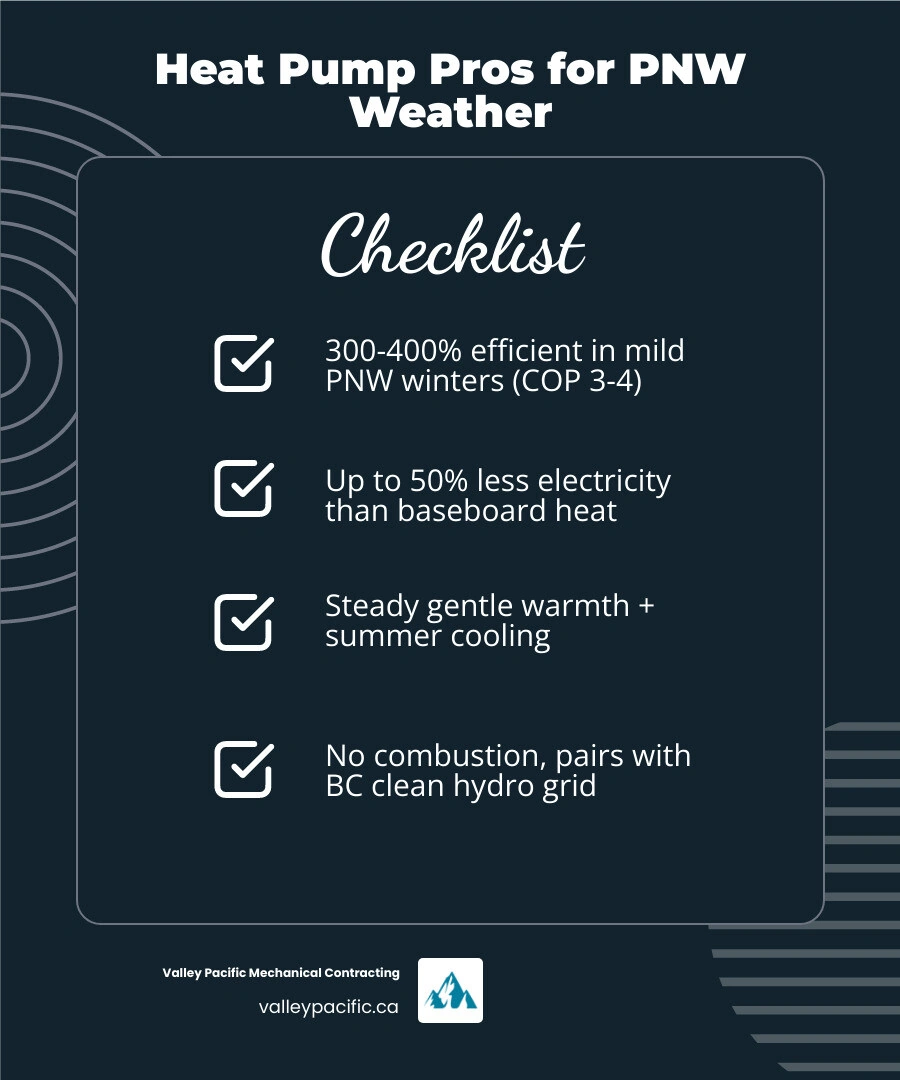
Heat pump pros and cons for pacific northwest weather: the quick answer
For most homes in Maple Ridge, Pitt Meadows, Langley, Mission, Surrey, and nearby Lower Mainland communities, heat pumps are a strong match for the climate. Our winters are usually cool and wet, not brutally cold. That matters because heat pumps do their best work in exactly those shoulder-season and mild-winter conditions.
In everyday terms, a heat pump usually means:
- efficient heating through most of winter
- built-in cooling for hotter summer days
- steadier indoor temperatures
- fewer combustion-related concerns
The tradeoff is that performance can dip during rare arctic blasts. When temperatures fall well below freezing, some systems need backup heat or a cold-climate model to keep up comfortably.
Why the Pacific Northwest is unusually heat-pump friendly
The Lower Mainland sits in a sweet spot for heat pumps. Winter temperatures often hover in the mid-30s to 40s Fahrenheit, which is well within the range where air-source heat pumps can deliver excellent efficiency. In these conditions, many systems can operate at a coefficient of performance, or COP, of roughly 3 to 4. Put simply, that means they can move 3 to 4 units of heat for every 1 unit of electricity they use.
That is why heat pumps have spread so quickly across the region. Research shows they are installed in more than a quarter of Pacific Northwest homes, and usage has risen sharply in recent years.
They also fit the direction many BC homeowners are already heading: cleaner, all-electric systems that pair well with our hydro-powered grid and provide both heating and cooling in one setup. If you want a deeper overview, our Residential Heat Pump Guide is a good next read.
Where heat pumps can struggle during rare cold snaps
Now for the honest part. Heat pumps are not magic boxes. During unusual cold snaps, they have to work harder to pull heat from outdoor air. Standard models can lose capacity as temperatures drop, and defrost cycles may temporarily affect output.
That does not mean they stop working. It means system choice and home condition matter more.
A few realities to know:
- real-world efficiency is often 20% to 30% lower than ideal lab ratings
- standard models may rely on electric strip heat during severe cold
- some homes benefit from dual-fuel setups or other backup heating strategies
- poorly insulated homes feel heat pump limitations faster than tight, well-sealed homes
Modern cold-climate heat pumps are much better than older generations. Some can maintain full heating capacity at 5°F and continue providing heat below zero. But in the Lower Mainland, whether you need that level of equipment depends on your home and microclimate, not just the weather report.
The biggest pros for BC and Pacific Northwest homeowners
The biggest advantage is simple: heat pumps line up extremely well with how we actually live in the Lower Mainland. We need winter heating, yes, but we also increasingly need summer cooling. One system can do both.
Other major benefits include:
- high efficiency in our mild winter weather
- all-electric operation
- quieter, more even comfort
- relief from summer heat waves
- lower emissions when paired with BC electricity
If you want a broader overview of benefits, see our guide on Reasons to Consider Heat Pump Installation.
Heat pump pros and cons for pacific northwest weather in everyday life
This is where the theory becomes practical.
If you are replacing baseboard heat, a heat pump can be a major comfort upgrade. If you are replacing an older furnace, the experience is different but still appealing. A heat pump usually delivers a gentler, steadier warmth instead of short bursts of very hot air. Some people love that because the home feels more consistently comfortable. Others miss the dramatic "warm blast" feeling a furnace gives on a cold morning. Neither reaction is wrong. It is mostly about preference.
In real life, many homeowners appreciate that heat pumps:
- keep temperatures more even from room to room
- avoid overheating and underheating swings
- help during both winter dampness and summer heat
- run quietly, especially variable-speed systems
- add cooling to homes that never had it before
Environmental benefits in a region with cleaner electricity
In BC, the environmental case for heat pumps is stronger than in places with dirtier power grids. Because much of our electricity comes from hydro, an all-electric heat pump generally has a lower carbon footprint than combustion-based heating.
That brings a few meaningful benefits:
- no on-site combustion
- no carbon monoxide risk from fuel burning equipment
- lower household emissions
- support for long-term electrification and decarbonization goals
For homeowners trying to reduce their environmental impact without sacrificing comfort, heat pumps make a lot of sense here.
Why hotter summers make heat pumps more attractive in the Lower Mainland
A lot of articles focus only on winter. In 2026, that misses half the story.
Lower Mainland summers are warmer than many homes were designed for. More houses are dealing with uncomfortable indoor temperatures, especially older homes without central AC. Heat pumps solve that by reversing operation and providing efficient cooling.
That means one system can help on a smoky August afternoon just as much as on a damp January morning.
For summer performance tips, see our Summer Efficiency Tips for Pacific Northwest Coastal Homes.

The main cons homeowners should weigh before switching
Heat pumps are a great fit for many homes, but they are not automatically the right fit for every home.
The most common drawbacks include:
- reduced output during extreme cold if the system is not designed for it
- year-round operation, which can mean more wear and more maintenance
- comfort expectations that differ from furnace heat
- poor results when equipment is oversized, undersized, or badly installed
- performance losses from leaky ducts or weak insulation
Regular upkeep helps a lot. Our Heat Pump Maintenance Tips cover the basics homeowners should know.
Heat pump pros and cons for pacific northwest weather during arctic blasts
Arctic blasts are rare in the Lower Mainland, but they are the weather events everyone remembers. They are also the moments that reveal whether a system was properly planned.
During these colder periods:
- standard heat pumps may lose enough capacity to need backup heat
- electric auxiliary heat may turn on automatically
- some homes are better served by a cold-climate unit
- exposed properties or colder inland pockets may need a more robust strategy
Modern cold-climate systems are impressive. Research shows some maintain full heating output at 5°F and can continue heating below zero. Still, not every home needs the most extreme cold-weather model. In many Lower Mainland neighborhoods, a standard high-efficiency heat pump is enough for most of the year, especially in a well-insulated house.
Why insulation, air sealing, and ducts matter more than many homeowners realize
A heat pump can only do so much if the house is leaking heat like a sieve. This is especially true in older, draftier homes with attic gaps, crawlspace leaks, tired weatherstripping, or neglected ductwork.
One of the biggest hidden issues is duct loss. In a typical Northwest house, roughly 30% to 60% of heat can be lost through leaky ducts before it ever reaches the rooms you want to warm. That is not a heat pump problem so much as a house problem, but it affects results dramatically.
Before or during installation, we recommend looking at:
- attic and wall insulation
- air sealing around windows, doors, and penetrations
- crawlspace and basement leakage
- duct sealing and insulation
- return air sizing and airflow balance
Maintenance needs in wet, coastal, and humid conditions
Wet Lower Mainland weather brings a few maintenance quirks.
Outdoor units need clear airflow and clean coils. Leaves, moss, dirt, and debris can build up faster in damp conditions. Condensate drains should stay clear. Filters need regular attention. And homeowners should understand that winter defrost cycles are normal, not a sign the unit is "giving up."
A simple maintenance routine usually includes:
- changing or cleaning filters on schedule
- keeping the outdoor unit free of debris and overgrowth
- checking drains and pans
- booking seasonal tune-ups
- making sure airflow is not blocked indoors or outdoors
Heat pumps vs furnaces in Pacific Northwest homes
For Lower Mainland homes, the question is not just "Which one heats?" Both do. The real question is how they feel, how they perform in our climate, and how they fit your home.
| Feature | Heat Pump | Furnace |
|---|---|---|
| Winter efficiency in mild BC weather | Very high | Depends on fuel and system efficiency |
| Summer cooling | Yes | No, not by itself |
| Heat feel | Steady and gentle | Hotter air, faster bursts |
| Extreme cold performance | Good to excellent, model-dependent | Strong regardless of outdoor temperature |
| Combustion | None | Present in fuel-burning systems |
| Retrofit potential | Often works with existing ducts | Often already in place in older homes |
Which feels more comfortable in a damp BC winter?
This is partly technical and partly personal.
Heat pumps tend to provide more even temperatures because they often run longer at lower output. Variable-speed systems are especially good at this. Many homeowners like the steady comfort and fewer temperature swings.
Furnaces usually deliver hotter supply air, so they can feel stronger and faster. Some people describe that as cozy. Others find it a bit dry or uneven.
In damp BC winters, many households prefer the consistency of a heat pump. But if you love that instant-toast feeling when warm air hits your socks, you may notice the difference.
Is switching from a furnace to a heat pump straightforward?
In many homes, yes. Existing ductwork can often be reused, which lowers the barrier to switching. But "can reuse ducts" does not mean "skip evaluation."
A proper retrofit should look at:
- duct condition and leakage
- airflow and return capacity
- thermostat compatibility
- electrical service needs
- equipment sizing based on the actual home, not rule-of-thumb guessing
That last point matters a lot. A heat pump that is too big or too small can disappoint even in perfect weather. Smart controls also help. Our guide to the Best Smart Thermostat Schedule for Pacific Northwest Coastal Weather explains how to get better day-to-day performance.
Do you need a cold-climate model or is a standard heat pump enough?
For many Lower Mainland homes, a standard high-efficiency heat pump is enough. Our winters are usually mild enough that extreme-cold performance is not needed every day.
That said, a cold-climate model is worth considering if you have:
- a more exposed property
- an inland or cooler microclimate
- a draftier home that will not be upgraded right away
- comfort concerns during rare freezes
- a desire to reduce reliance on backup heat
The right answer depends on your home, not just the brochure.
Choosing the right system for your home type in the Lower Mainland
The best heat pump setup depends heavily on house type. A newer home with solid ductwork has different needs than an older character home with no ducts at all.
Ducted heat pumps for homes with usable existing ductwork
If your home already has decent ducts, a central ducted heat pump may be the most seamless option. It can provide whole-home heating and cooling through familiar vents and can often be integrated into an existing forced-air layout.
Ducted systems are often a strong fit for:
- homes replacing older central systems
- families wanting one thermostat and whole-home comfort
- renovations where ducts can be improved at the same time
- homes with enough space for proper filter and airflow upgrades
Ductless heat pumps for older homes without ducts
Older BC homes often do not have ductwork, and adding it can be disruptive. That is where ductless systems shine. A ductless mini-split can provide zoned comfort without tearing open walls for full duct installation.
They are especially useful for:
- older homes without existing ducts
- finished basements
- room additions
- suites
- targeted comfort problems in specific areas
If that sounds like your home, read Is a Ductless System Right for Your BC Home.
Indoor air quality and humidity control in rainy Pacific Northwest weather
Heat pumps can also improve everyday indoor comfort beyond just temperature.
In cooling mode, they remove moisture from the air, which can help during muggy periods. With proper filtration and ventilation, they can also support better indoor air quality by reducing stale air issues and helping control airborne particles.
Important note: a heat pump is not a substitute for ventilation or fixing moisture intrusion. If a home has leaks, poor bathroom exhaust, or chronic dampness, those issues still need attention. But as part of a full comfort strategy, a heat pump can help a home feel less sticky, more stable, and easier to live in.
For more on this topic, see How Ductless Systems Handle Humid Coastal Weather


