


Ultimate Checklist for Atmospheric Rivers and King Tides Flood Protection


Worried About Flooding in the Lower Mainland? How Do Atmospheric Rivers and King Tides Affect My Home?
Understanding how atmospheric rivers and king tides affect your home could be the difference between a manageable cleanup and serious structural damage. For homeowners across the BC Lower Mainland — from Maple Ridge and Langley to Surrey and Vancouver — these two weather forces are a very real seasonal threat, and they're becoming more frequent and more intense.
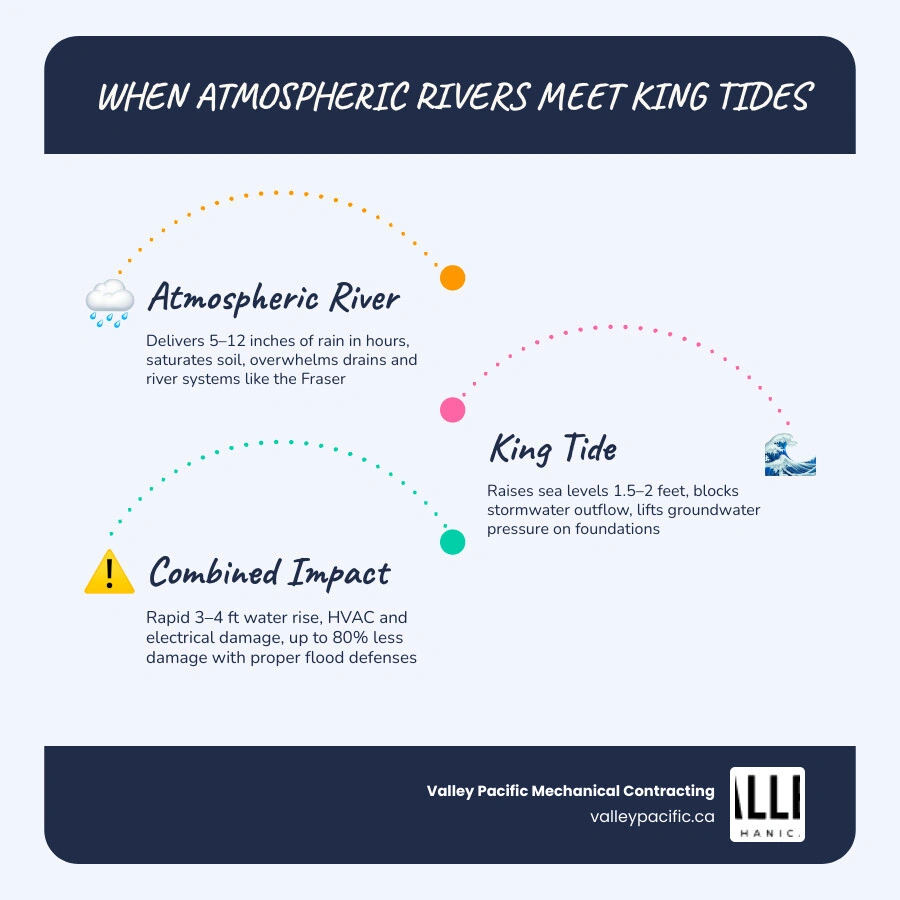
Here's a quick overview of the key ways these events impact your home:
How Atmospheric Rivers Affect Your Home:
- Deliver intense, sustained rainfall that overwhelms gutters, drains, and foundation drainage
- Saturate soil rapidly, increasing risk of basement flooding and landslides
- Can dump 6–12 inches of rain on the Cascades and 5–10 inches on the Olympics in a single event
- Cause river systems — including the Fraser River — to swell toward flood stage
- Overwhelm municipal stormwater systems, backing up into basement drains and sewer lines
How King Tides Affect Your Home:
- Push ocean and tidal water levels 1.5 to 2 feet above normal high-tide marks
- Cause "sunny-day flooding" in low-lying coastal areas with no rain required
- Slow or block the outflow of stormwater drainage into tidal waterways
- Raise groundwater tables, increasing pressure on foundations and crawlspaces
- Compound rapidly when combined with an atmospheric river or storm surge event
When They Happen Together:
- Water levels can rise 3–4 feet above normal within minutes
- Standard flood defenses are often overwhelmed
- HVAC systems, sump pumps, electrical panels, and water heaters face the greatest risk
- Homes with no mitigation measures in place can suffer severe structural and mechanical damage
These aren't rare worst-case scenarios anymore. King tide flooding events have increased by over 150% since 2000, and many coastal and riverside communities in the Lower Mainland now face this double threat multiple times each year. The good news is that homes with flood-resistant modifications experience up to 80% less damage — and preparation doesn't have to be complicated.
This guide walks you through exactly what to do, from quick protective steps before a storm to long-term upgrades that keep your home and mechanical systems safe season after season.
Understanding How Atmospheric Rivers and King Tides Affect Your Home
To protect your property, you first need to understand the science behind these forces and how they conspire to flood your basement, crawlspace, or yard.
An atmospheric river is essentially a massive, flowing corridor of concentrated water vapor in the sky—often nicknamed the "Pineapple Express" when it originates near Hawaii. When these sky-rivers hit the mountainous terrain of British Columbia, they release torrents of warm, heavy rain. Because the air is warm, snow levels in the mountains rise rapidly, causing existing snowpacks to melt and adding millions of gallons of runoff to our local river basins.
At the same time, a king tide is a non-scientific term for exceptionally high astronomical tides. These occur when the orbit of the moon is closest to the Earth (known as perigee) and aligns perfectly with the sun, compounding their gravitational pull on our oceans.

When these two events happen at the same time, they create a hydraulic "bottleneck." The massive volume of rainwater brought by the atmospheric river rushes down the Fraser River and local tributaries, trying to escape into the Pacific Ocean. However, the king tide pushes ocean water inland with immense force.
With nowhere to go, the water backs up. Storm sewers overflow, groundwater tables spike, and municipal drainage systems fail. This is why understanding How Lower Mainland Climate Affects Your HVAC System is so vital—extreme moisture and local climate shifts directly dictate how hard your home's mechanical systems have to work to keep you dry and comfortable.
What is an Atmospheric River and How Does It Form?
Atmospheric rivers are responsible for the vast majority of mid-latitude annual rainfall along the Pacific coast. When these moisture plumes stall over the Lower Mainland, the sheer volume of water is staggering. During a single major storm event, the Cascades can receive 6 to 12 inches of rain, while the Olympic Peninsula and our local Coast Mountains can see 5 to 10 inches.
Because the air carried within these systems is tropical or sub-tropical, the freezing level rises dramatically. Instead of snow falling on the peaks and staying there, rain falls directly on mountain snow. This rain-on-snow effect causes immediate, rapid runoff that overwhelms local creeks, rivers, and residential drainage systems.
What is a King Tide and Why Does It Occur?
A king tide is a predictable, natural event caused by celestial mechanics. When the Earth, moon, and sun align during a new or full moon at perigee, their combined gravitational pull maximizes.
These tides can cause what is known as "sunny-day flooding"—coastal or riverside inundation that happens even when there isn't a cloud in the sky. While a king tide on its own might only cause minor pooling on coastal roads or docks, it becomes incredibly dangerous when low barometric pressure from a winter storm system or heavy rainfall accompanies it, raising the water table and preventing land-based water from draining away.
Vulnerable Areas and the Severity of Storm Damage
The impact of these weather patterns is not felt equally across the Lower Mainland. Depending on where your home is located, you might face different types of water and structural hazards.
| Flood Hazard Type | Primary Cause | Typical Impact Areas | Key Home Vulnerabilities |
|---|---|---|---|
| Overland Flooding | Atmospheric River | Low-lying river basins, sloped properties | Basements, crawlspaces, foundation walls |
| Tidal Inundation | King Tide | Coastal shorelines, tidal river outlets | Low-lying yards, garages, storm drains |
| Sewer Backup | Combined Storm & Tide | Municipalities with older infrastructure | Basement drains, low-level plumbing fixtures |
| Groundwater Seepage | Saturated Soil | High-water-table areas (Pitt Meadows, Langley) | Sump pumps, concrete foundations, utility rooms |
If your home's mechanical systems fail during one of these events, it can quickly escalate. Knowing When an HVAC Failure is a True Emergency is crucial, especially when rising waters threaten electrical connections, heating units, or indoor air quality.
Identifying High-Risk Properties and How Atmospheric Rivers and King Tides Affect Your Home
Properties located in low-lying areas, historic floodplains, or near the Fraser River are naturally at the highest risk. Municipalities like Pitt Meadows (which relies heavily on a complex system of dikes and pumps) and low-lying sections of Maple Ridge, Langley, and Surrey are highly susceptible to groundwater pressure and overland flooding.
If your home has a basement suite or a deep crawlspace, you are particularly vulnerable. When the water table rises, hydrostatic pressure forces water through microscopic cracks in your concrete foundation. Understanding how atmospheric rivers and king tides affect your home means recognizing that water doesn't just come from the sky or the river—it can rise up directly from the ground beneath your feet.
Mechanical and Plumbing System Vulnerabilities
Your home’s mechanical systems are its first line of defense, but they are also the most vulnerable to water damage:
- Sump Pumps: These are your primary defense against rising groundwater. However, they rely on electricity. If an atmospheric river brings high winds that knock out power lines, an unprotected sump pump will stop working exactly when you need it most.
- Drain Tiles: The perforated pipes running around your foundation can easily become clogged with silt, leaves, and debris washed down by heavy rains, leading to immediate basement seepage.
- Plumbing Backflow: When municipal storm and sanitary sewers fill to capacity, sewage can back up through your home’s lowest drains.
- HVAC Systems: Outdoor heat pumps and air conditioners can be ruined if standing water submerges their electrical components, while indoor furnaces located in damp basements are prime targets for water damage and rust.
To keep these systems running smoothly, regular checkups are essential. Following proactive HVAC Preventative Maintenance Tips ensures your heating and cooling systems are resilient enough to handle seasonal storm surges.
Step-by-Step Flood Protection Checklist for Homeowners
When a storm is on the horizon, every minute counts. Having a structured plan allows you to protect your property efficiently, shifting from reactive panic to organized preparation.
Proactive steps are always the safest way to reduce risk. Investing in regular upkeep and learning How to Prevent HVAC Emergencies with Maintenance can save you from catastrophic system failures when the weather turns severe.
Immediate Actions Before, During, and After a Storm
1. Before the Storm (48-Hour Window)
- Clear Gutters and Downspouts: Remove leaves, pine needles, and debris. Ensure downspouts direct water downhill and at least six feet away from your foundation.
- Test Your Sump Pump: Pour a bucket of water into the sump pit to ensure the float switch activates and the pump clears the water quickly.
- Clear Street Drains: If there is a storm drain on the road outside your house, clear away any leaves or trash blocking it.
- Prepare Sandbags: If you live in a low-lying zone, place sandbags or temporary water barriers around basement window wells, garage doors, and low entryways.
2. During the Storm
- Monitor Water Levels: Keep an eye on your basement, crawlspace, and yard drainage.
- Unplug Low-Level Electronics: If you suspect water is beginning to seep into your basement, safely unplug floor-level appliances and electronics.
- Be Ready to Shut Off Utilities: If water threatens to submerge your furnace, water heater, or electrical panel, shut off the main power breaker and gas valve before the water reaches them. Never enter a flooded basement if the power is still on.
3. After the Storm (Recovery Phase)
- Document Everything: Take timestamped photos and videos of any water intrusion or damage before you begin cleanup.
- Dry the Area Quickly: Mold can begin to colonize wet building materials within 24 to 48 hours. Use heavy-duty fans and dehumidifiers to dry out affected spaces.
- Check Moisture Levels: Ensure wood framing and drywall have a moisture content below 12% before sealing them back up or laying down new flooring.
Long-Term Structural Upgrades and How Atmospheric Rivers and King Tides Affect Your Home
While immediate actions help during a crisis, long-term structural upgrades offer the ultimate peace of mind. Statistics show that properties with multi-layered flood defenses experience up to 70% less structural damage during king tide and storm surge events.
- Elevate Mechanical Equipment: Have a licensed technician raise your outdoor heat pump, indoor furnace, water heater, and electrical panels at least 24 inches above your home's base flood elevation.
- Install a Backwater Valve: This one-way valve is installed on your main sewer line. It allows wastewater to leave your home but automatically seals shut if municipal sewage begins backing up toward your drains.
- Add Sump Pump Battery Backups: Install a high-quality backup pump powered by a marine-grade battery system. If the power goes out during an atmospheric river, the backup pump will keep your basement dry for hours.
- Upgrade Foundation Drainage: Ensure your perimeter drain tiles are flushed, inspected, and repaired. Consider sealing foundation cracks from the exterior with waterproofing membranes.
Navigating Flood Insurance and Community Resilience Programs
One of the most common gaps homeowners discover is assuming their standard home insurance policy covers flood damage.
Standard homeowners insurance policies typically exclude overland flooding and tidal storm surges.
To be protected against these events, you must explicitly add specific coverages to your policy:
- Overland Water Protection: This covers water that enters your home from freshwater sources, such as overflowing rivers, heavy rainfall accumulation, or surface water runoff.
- Sewer Backup Rider: This covers damage caused by water or sewage backing up through your toilets, sinks, or floor drains.
- Tidal Surge Exclusions: Be aware that even with overland water protection, some policies still exclude damage caused by ocean saltwater, high tides, or marine storm surges. Always read the fine print and speak directly with your insurance provider about your specific local risks.
Fortunately, local governments across the Lower Mainland are working hard to build community resilience. Municipalities are investing in stronger dike systems, larger pump stations, and advanced flood-monitoring networks. Community-level flood mitigation helps reduce disruption and supports safer neighbourhoods during severe weather.
As a homeowner, you can stay informed by checking municipal flood maps, subscribing to local emergency alert systems (like Alertable), and monitoring BC River Forecast Centre advisories during heavy rain events.
Frequently Asked Questions about Coastal and Rainfall Flooding
Does standard home insurance cover damage from atmospheric rivers?
No. Standard home insurance policies in British Columbia do not automatically cover water damage caused by overland flooding, river overflows, or surface water pooling from heavy rain. You must purchase optional Overland Water Protection and a Sewer Backup Rider to be covered for these specific types of storm damage.
How do I know if my Lower Mainland home is in a flood zone?
You can consult the official flood hazard maps provided by your local municipality (such as the City of Maple Ridge, City of Langley, or City of Surrey) or access provincial mapping databases. These resources outline the Fraser River floodplain boundaries and identify areas vulnerable to 100-year and 200-year flood events.
What should I do if my heating or plumbing system gets flooded?
If water reaches your furnace, boiler, heat pump, or water heater, do not attempt to turn them back on. Doing so can cause catastrophic electrical shorts, gas leaks, or fires. Immediately shut off the power at the main breaker, close the gas valve, and call a professional.
You must have a licensed technician perform a thorough safety inspection, clean the components, and verify the integrity of the system before it can be safely operated again. Regular preventative care can help prevent these emergencies entirely; read more on How to Prevent HVAC Emergencies with Maintenance.
Conclusion
Protecting your home from the combined forces of atmospheric rivers and king tides requires a mix of quick seasonal habits and smart, long-term upgrades. By keeping your gutters clear, testing your sump pump, and elevating critical mechanical equipment, you can dramatically reduce your risk of serious flood damage.
At Valley Pacific Mechanical Contracting, we have over 30 years of expertise helping homeowners throughout Maple Ridge, Pitt Meadows, Langley, and the wider Lower Mainland keep their homes safe, dry, and comfortable. As an Indigenous-owned HVAC and mechanical services company, our licensed technicians support heating, cooling, plumbing, sump pump, backwater valve, installation, renovation, and maintenance needs with a friendly, customer-first approach and fast local response.
Don't wait for the next storm warning to find out if your home is ready. Schedule professional HVAC and plumbing support in the Lower Mainland with our team today, and let's make sure your property is fully protected.


