


When to Repair vs Replace Your HVAC System


Is It Time to Repair or Replace Your HVAC System? Here's How to Know
Knowing when to repair vs replace your HVAC system is one of the most stressful decisions a homeowner can face — and it almost always seems to happen at the worst possible moment, like when the heat goes out on a cold Lower Mainland morning or the AC stops working in the middle of a summer heat wave.
The stakes are real. Repair the wrong system and you may be right back in the same situation six months later. Replace too soon and you've spent money you didn't need to. Getting this decision right means looking at the full picture: your system's age, repair history, efficiency, comfort performance, and safety.
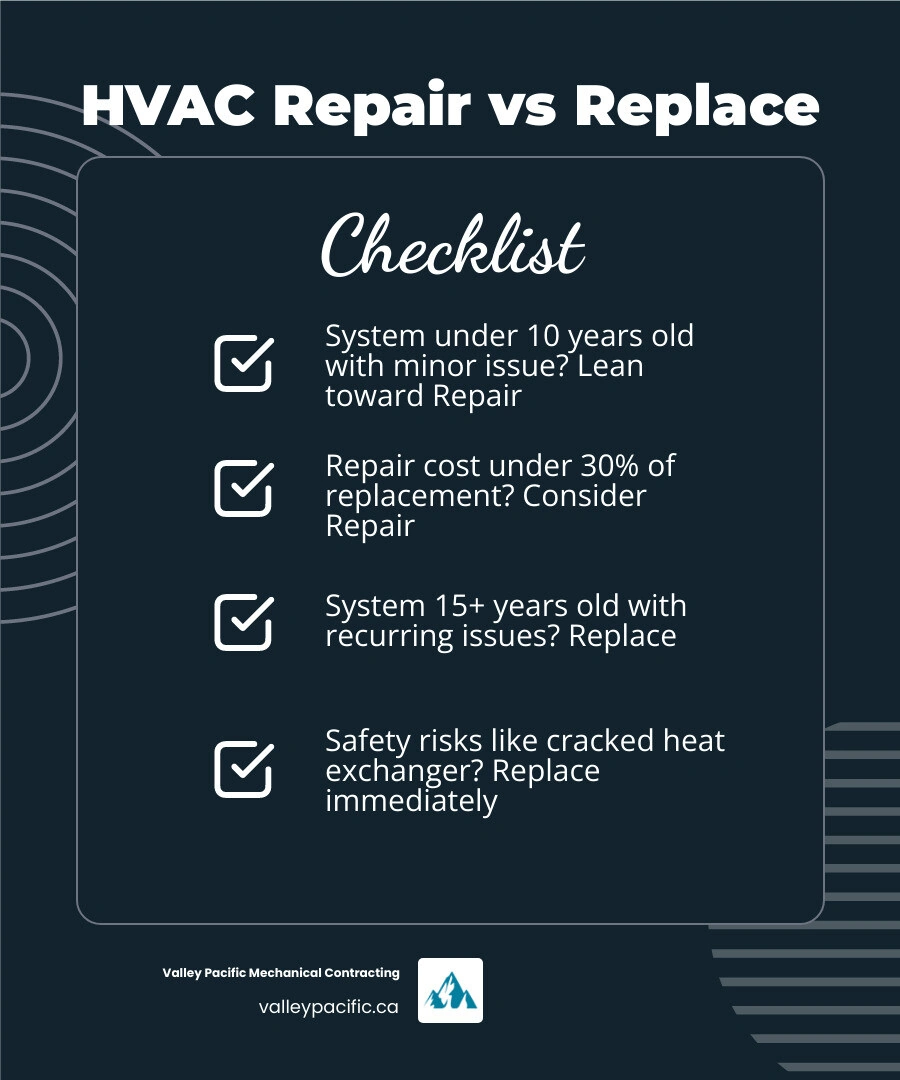
Here's a quick-reference guide to help you decide:
| Situation | Lean Toward |
|---|---|
| System is under 10 years old with a minor issue | Repair |
| Repair cost is under 30% of replacement cost | Repair |
| Active manufacturer warranty covers the part | Repair |
| Energy bills are stable and comfort is consistent | Repair |
| System is 15+ years old with recurring breakdowns | Replace |
| Repair cost exceeds 50% of a new system's cost | Replace |
| System uses R-22 refrigerant (no longer produced) | Replace |
| Cracked heat exchanger or carbon monoxide risk detected | Replace immediately |
| 3 or more repairs needed in the past 3 years | Replace |
| Comfort has declined despite recent repairs | Replace |
The sections below walk through each of these factors in detail — so you can make a confident, informed decision for your home.
When to Repair vs Replace Your HVAC System: The Biggest Signs to Watch
The first clue is usually not a dramatic breakdown. It is often a pattern. Maybe one room is too hot, another is too cold, the airflow feels weak, or the system sounds like it is rehearsing for a garage band.
Common warning signs include:
- Uneven temperatures between rooms
- Weak airflow from vents
- Short cycling
- Strange noises like banging, squealing, or rattling
- Higher indoor humidity
- Rising energy bills without a clear reason
- Excessive dust around vents
- A system that runs longer and longer to do the same job
These signs do not automatically mean replacement. Sometimes they point to a repair. Sometimes they point to a larger system issue. If you are seeing several at once, it is smart to start with a professional evaluation and a full HVAC system check. You can also review common warning signals in our guide to signs your HVAC system may fail soon.

Signs your HVAC system is usually worth repairing
Repair is often the better choice when the system is still relatively young and the problem is isolated.
In many homes, repair makes sense when:
- The unit is under 10 years old
- The issue is minor, like a clogged filter, faulty thermostat, capacitor, contactor, or drain problem
- Your utility bills have stayed fairly stable
- The system has been reliable up to this point
- The failed part is covered under warranty
- Comfort returns to normal once the repair is made
This is especially true if the technician can point to one failed component rather than a chain of age-related issues. A newer system with one bad part is not the same as an older system that is slowly falling apart one component at a time.
Signs replacement is often the smarter long-term move
Replacement usually becomes the better path when the problem is no longer just one part.
That often looks like:
- Repeated breakdowns over the last few years
- Major component failure, such as a compressor, coil, or heat exchanger
- Declining comfort even after repairs
- Poor airflow or constant running
- Very noisy operation
- Humidity problems that never seem to improve
- Outdated refrigerant
- A system that no longer fits the home's needs
If the equipment still runs but your comfort is getting worse, that matters. "Still running" and "still working well" are not the same thing.
How Age, Efficiency, and Performance Change the Repair vs Replace Decision
Age matters, but it should not be the only thing driving the decision. A well-maintained system can outlast a neglected one, while poor installation or skipped maintenance can shorten lifespan.
As a general rule in 2026:
- Air conditioners typically last 12 to 15 years
- Furnaces often last 15 to 20 years
- Heat pumps usually last 15 to 20 years, though heavy year-round use can shorten that
If you are not sure how your equipment stacks up, our article on how old is too old for an HVAC system is a helpful place to start. Ongoing tune-ups also play a major role, which is why regular HVAC preventative maintenance matters so much.
When to repair vs replace your HVAC system based on age
A simple age-based framework can help:
- Under 10 years old: Repair is usually reasonable if the issue is minor and the system has a good maintenance history.
- 10 to 15 years old: This is the gray zone. Look closely at repair frequency, efficiency, refrigerant type, and comfort.
- 15 years or older: Replacement often deserves serious consideration, especially if performance is declining or repairs are becoming more common.
Age alone does not force replacement. But as systems get older, they tend to enter a stage where failures come in clusters. One repair buys time, then another part gives out. Then another. That is when homeowners start feeling like the HVAC system has turned into a subscription nobody wanted.
Rising energy bills and declining efficiency: when repair no longer solves the problem
One of the strongest replacement signals is a steady increase in energy use without a major change in how you live.
Older systems lose efficiency over time. Even if they technically run, they may use far more energy to keep your home comfortable. Research shows that modern HVAC systems can reduce monthly energy costs by roughly 20% to 40% compared to older equipment. ENERGY STAR-certified models can save an additional 15%, and replacing an older cooling system with a modern high-efficiency unit can reduce cooling energy use by over 35%.
That is a big deal for homes in Maple Ridge, Mission, Langley, and surrounding Lower Mainland communities where we rely on HVAC systems through both damp winters and warmer summer stretches.
Efficiency ratings also matter:
- SEER2 measures cooling efficiency for air conditioners and heat pumps
- AFUE measures furnace efficiency
- HSPF2 measures heating efficiency for heat pumps
If your system is older, oversized, undersized, or simply worn out, a repair may restore operation without restoring efficiency. In that situation, the equipment may keep running while quietly draining more energy month after month.
The Decision Rules Homeowners Can Use Before Saying Yes to Another Repair
There is no single perfect formula, but a few industry rules of thumb can help organize the decision.
Use them as decision tools, not absolute laws. They work best when combined with age, warranty status, repair history, comfort, and safety.
| Repair-friendly situation | Replacement-friendly situation |
|---|---|
| Newer system with isolated problem | Older system with repeated breakdowns |
| Stable utility bills | Rising bills and declining performance |
| Repair is minor and infrequent | Repair is major or one of several recent repairs |
| Warranty covers key parts | Out of warranty with aging components |
| Home is comfortable after service | Comfort problems continue after service |
What is the $5,000 rule for when to repair vs replace your HVAC system?
The $5,000 rule is a simple way to add perspective.
Multiply:
- The age of the system
- By the cost of the repair
If the total is over $5,000, replacement usually makes more sense.If the total is under $5,000, repair often makes more sense.
Example:
- An 8-year-old system with a moderate repair may lean toward repair
- A 14-year-old system with the same repair may lean toward replacement
This rule is useful because it gives more weight to age. Spending heavily on an older unit often produces less long-term value than spending the same amount on a younger one.
Still, it is only a guideline. It does not account for warranty coverage, comfort issues, refrigerant type, or safety problems, so it should never be the only thing you use.
When the 50% rule and repeated repairs point toward replacement
Another common rule is the 50% rule:
- If a repair is more than 50% of the cost of replacement, replacement usually deserves the stronger look.
There is also a practical lower threshold many homeowners use:
- If repair is under 30% of replacement and the system is otherwise in good shape, repair often makes sense.
Then there is repair history. If you have needed three or more repairs in the last three years, that is often a sign of systemic decline rather than bad luck.
Repeated repairs matter because each one only addresses today's failure. They do not rewind the age of the rest of the machine. A new part inside a worn-out system can help, but it cannot make old motors, coils, controls, and wiring suddenly young again.
Why warranty status can tip the decision toward repair
Warranty coverage can shift the decision toward repair, especially on newer systems.
Things to ask about include:
- Is the failed part still under manufacturer warranty?
- Is the compressor or heat exchanger covered?
- Is labor covered, or just the part?
- Has the equipment been maintained in a way that keeps the warranty valid?
If a major part is covered, repairing a newer unit may be the smartest move. If the system is out of warranty and multiple aging components are showing wear, replacement starts looking more practical.
This is one reason we recommend asking for both repair and replacement options during an evaluation, rather than deciding based only on the first problem found.
Safety and Refrigerant Issues That Make Replacement the Safer Choice
Some HVAC decisions are financial. Others are safety decisions, full stop.
If a technician finds a serious combustion or electrical hazard, replacement may be the only responsible option. For homeowners, safety should always outrank squeezing one more season out of old equipment.
Our broader resources on residential HVAC solutions and HVAC services for home comfort can help you understand what a safer, more reliable system should deliver.
Safety red flags that require immediate replacement
Call for service right away if you notice:
- A carbon monoxide alarm going off
- A cracked heat exchanger
- A yellow or flickering furnace flame instead of a steady blue one
- Burning smells that do not quickly clear
- Breakers tripping repeatedly when the system runs
- Signs of electrical overheating
- A furnace that shuts down unexpectedly and cannot operate safely
A cracked heat exchanger is one of the biggest red flags. It can create a carbon monoxide risk, and this is not a "maybe next year" problem. If combustion safety is compromised, replacement is typically the right move immediately.
Why outdated refrigerants like R-22 change the repair vs replace equation
If your air conditioner or heat pump uses R-22 refrigerant, the decision changes fast.
R-22 has been phased out, which means it is no longer produced. That makes repairs involving leaks or recharging much more difficult and much less appealing long-term. Even if the unit can technically be repaired, you are still left with older equipment built around an outdated refrigerant.
In most cases, if an R-22 system develops a refrigerant problem, replacement is the smarter long-term solution.
Why Replacing an Older HVAC System Can Improve Comfort, Air Quality, and Home Value
A replacement is not just about avoiding breakdowns. It can also improve how your home feels every day.
Modern systems can offer:
- More even temperatures
- Better humidity control
- Quieter operation
- Improved filtration and indoor air quality
- Smart thermostat compatibility
- Zoning options in some homes
- Better overall reliability
That is why replacement can be worthwhile even when the old system still technically works. If your home has persistent hot and cold spots, clammy air, noisy startup, or constant airflow complaints, a newer system may solve problems repairs never fully fix.
You can learn more in our guides on how a new HVAC system increases home value, HVAC system upgrades, HVAC system design, and tailored HVAC services for homes.
Comfort problems that often mean replacement deserves a closer look
Some issues seem like repair problems but are really system design or age problems.
Examples include:
- Rooms that are always hotter or colder than the rest of the house
- Weak airflow throughout the home
- Humidity swings
- A system that runs constantly but never quite catches up
- Equipment that is too small or too large for the home
- Duct issues affecting pressure and air delivery
In these cases, simply replacing one failed part may not solve the bigger problem. A full evaluation of equipment sizing, ductwork, airflow, and controls may reveal that replacement is the better route.
Questions to ask an HVAC professional before you decide
A good evaluation should help you understand the whole picture, not just the broken part.
Ask questions like:
- What exactly failed?
- Is this an isolated issue or part of a larger pattern?
- How much useful life is realistically left in the system?
- Are there signs of additional wear on major components?
- Is the system properly sized for the home?
- Should the ductwork, airflow, or static pressure be checked too?
- Will this repair restore normal comfort and efficiency, or just get it running again?
- Is the refrigerant current and readily supported?
- Is the part under warranty?
- Can you provide both a repair option and a replacement option so we can compare them clearly?
That last question matters. A side-by-side explanation usually makes the decision much easier and helps you avoid reacting emotionally in the middle of a breakdown.
Conclusion
Deciding whether to repair or replace an HVAC system is really about looking beyond the immediate symptom. Age, repair frequency, warranty coverage, comfort, efficiency, refrigerant type, and safety all matter.
In general:
- Repair makes the most sense for newer systems with isolated problems, stable performance, and warranty support.
- Replacement makes more sense for older systems with repeated breakdowns, comfort issues, efficiency decline, R-22 refrigerant, or safety concerns.
If your system is in that middle ground, the best next step is a professional whole-home evaluation. In many Lower Mainland homes, planning ahead during the spring or fall shoulder season is far less stressful than waiting for a mid-winter heating failure or a summer cooling emergency.
At Valley Pacific Mechanical Contracting, we help homeowners in Maple Ridge, Pitt Meadows, Langley, and Mission make this decision with clear information and a headache-free process. Whether you need a repair, a second opinion, or a full system replacement plan, we are here with 24/7 emergency service and more than 30 years of experience.
For the next step, explore More info about services.


